
Hector Berlioz
The Romantic PeriodTime is a great teacher. Unfortunately, it kills all its students."
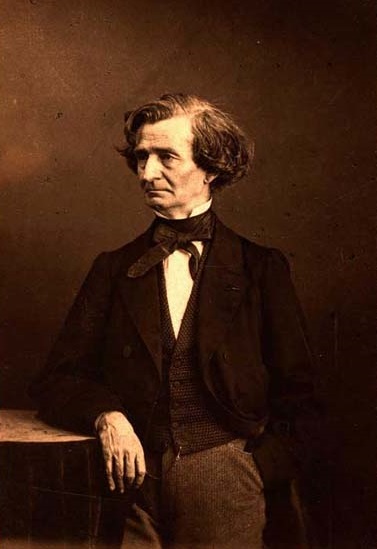
Public domain, via Wikimedia Commons
Hector Berlioz originally trained to practice medicine, but after graduating from medical school, decided to pursue music instead, much to his parents' distaste. He first gained the attention of the music community as a critic, decrying the influence of Rossini and other Italian composers on French opera. He began composing on his own, and entered the Paris Conservatoire in 1826 and began submitting compositions in attempts to win the "Prix de Rome," a prestigious music award that included a state-funded trip to study in Rome.
It was also around this time he developed a passion for Shakespeare, and in particular, a Shakespearean actress named Harriet Smithson. He became obsessed with her and started sending her love letters, but she returned to Ireland without meeting him.
In the summer of 1830, Berlioz was in Paris during the July Revolution. He later recalled composing while listening to bullets ricochet outside his apartment while composing an equally revolutionary work, Symphonie Fantastique. This work had a programmatic structure and used extended techniques, or instruments being used in non-traditional ways to produce unique sounds.
Some examples of extended techniques include:
- Pizzicato: String instruments pluck the strings instead of using the bow.
- Con Sordino: Brass or string instruments use a mute to alter the sound of the instrument.
- Col Legno: String instruments flip their bows over and tap the strings with the wood.
- Glissando: Vocalists, strings, and trombones can slide from one pitch to another. This technique can be replicated in other brass and woodwind instruments by manipulating the embouchure.
Symphonie Fantastique also includes one of the first examples of a composer reaching back into music history for material: the fifth movement prominently features the Dies Irae, a Gregorian Chant used at requiem masses.
Symphonie Fantastique was precisely not what the judges of the Prix de Rome were looking for, so he composed a much more conservative cantata called La Mort de Sardanapale, which finally won the prize.
Before leaving Paris, Berlioz got engaged to a woman named Marie Moke, but by the time he travelled to Italy (the reward for winning the Prix de Rome), he learned that she had broken off the engagement and married a wealthy piano manufacturer. Furious at her and her mother (to whom he referred in his journal as "the hippopotamus"), Berlioz bought several vials of poison, a brace of pistols, and a dress to disguise himself as a lady's maid so that he could murder them both. Fortunately, he had cooled off and changed his mind by the time he returned to Paris.
Berlioz returned to Paris the next year. Harriet Smithson finally accepted an invitation to hear one of his concerts, and was impressed by Symphonie Fantastique as well as the company he kept, with friends including Franz Liszt, Frédéric Chopin, Niccolò Paganini, and even authors such as Victor Hugo and Alexandre Dumas. After Berlioz threatened to kill himself by drinking poison unless she married him, Smithson and Berlioz were married. Paganini paid off Berlioz's debts after hearing a performance of "Harold in Italy," and Berlioz's symphony "Roméo et Juliette" was a financial success.
Throughout the remainder of his career, Berlioz struggled to be accepted in France's more conservative musical culture, and found more success abroad, especially in Germany. His wife died in 1854 and Berlioz married his mistress, but she died in 1862. He continued composing in an avant-garde style, notably writing an opera called Les Troyens, which was never fully staged in Berlioz's lifetime, and a depressed Berlioz retired from composing after this, though he continued to conduct and critique. His health deteriorated throughout the 1860s and after stomach issues and a stroke, he died in 1869.